I don’t like Pushka. I should do, but I don’t. Even with the camels.
We spent a fairly uneventful five hours or so driving up from Udaipur to Pushka and there were only two memorable things of note:
- At one point on the journey there were twenty to thirty miles of marble yards along the side of the road. India and Italy are apparently the world’s biggest exporters.
- As we entered Pushka, the traffic got incredibly busy and a 4WD vehicle clipped the wing mirror of our car and broke the glass. Santos was obviously upset but, true to his Hindu faith, the only thing he said was that ‘people need to be more relaxed’.
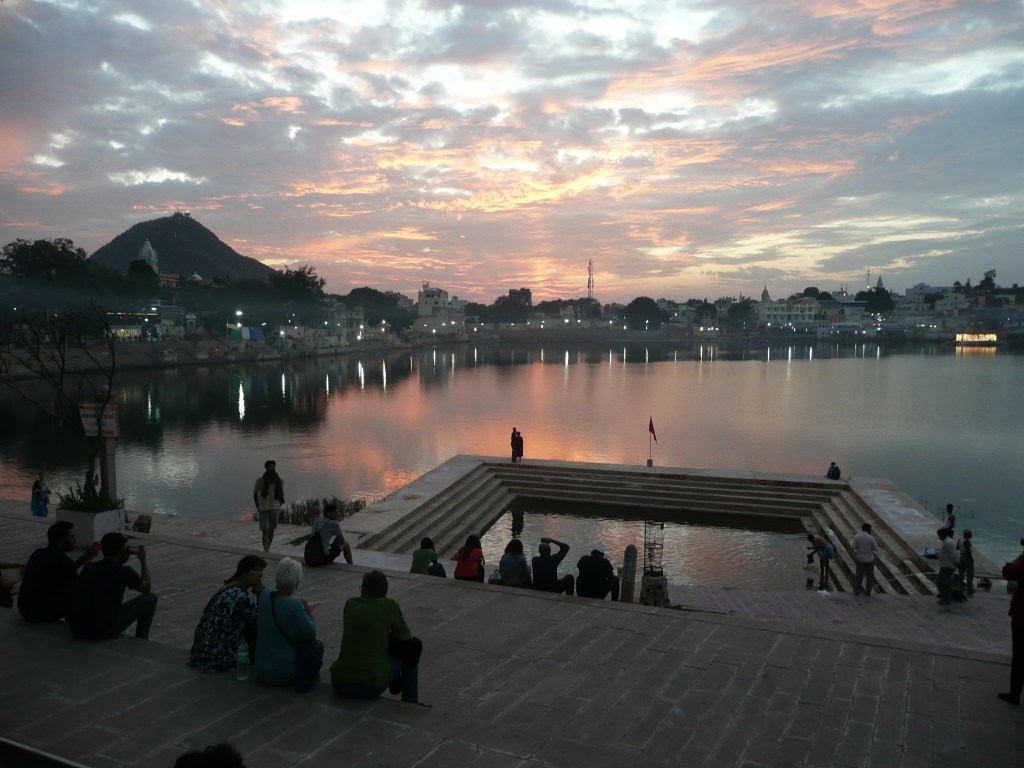
On first appearances Pushka looks like the ideal place to relax. It’s built around a beautiful lake and from our hotel you can see the sun setting in the distance.
But appearances can be deceiving. It’s an Indian version of Lourdes – with camels. The noise of being called to prayer, the chanting and the bloody bells is relentless.
Pushkar Lake is sacred to Hindus and described in Hindu scriptures as ‘the king of pilgrimage sites related to a water body’. When I looked up why, a ninth-century king once chased a white boar to the lake shore on a hunting expedition. Being thirsty, instead of popping in to one of the hotels for a beer, he dipped his hand into the lake and was astonished to see that the severe loss of pigmentation on his hand disappeared.
The King was so impressed with the sacred curative nature of the lake that he restored the area to its current glory. It now has 52 bathing ghats (stepped areas down to the lake) and the whole thing is a major pilgrimage site.
Men and women come here in their thousands to take a sacred bath in the waters. A dip in the lake is believed to cleanse sins and is meant to be particularly good for curing skin diseases.
I think this must be how homeopathic medicine works. After all, what could possibly be better for a skin disease than bathing in the same water that other people with skin diseases have used.
It’s like a giant Jacuzzi – but not as warm.
 Dave and Annette in India and Nepal